
Introduction
In the ever-evolving realm of transportation, where the trifecta of efficiency, safety, and sustainability reign supreme, Artificial Intelligence (AI) emerges as the vanguard of transformative innovation. With its unparalleled capacity to ingest, analyze, and interpret vast troves of data in real-time, coupled with its adaptability to dynamic conditions, AI stands poised to redefine the very essence of how people and goods traverse from one point to another. In this exhaustive discourse, we embark on an immersive journey into the multifaceted advantages conferred by AI within the transportation milieu, delving deep into pivotal domains such as autonomous vehicles, traffic optimization, and predictive maintenance for public transit systems.
Autonomous Vehicles: A Paradigm Shift in Mobility Dynamics
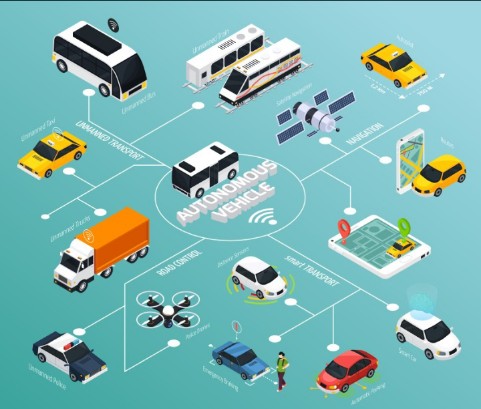
At the forefront of transportation innovation lies the epochal advent of autonomous vehicles (AVs), heralding a seismic shift in mobility dynamics. Equipped with a formidable arsenal comprising state-of-the-art sensors, precision cameras, and cutting-edge AI algorithms, AVs possess an unparalleled acumen to discern and navigate the intricacies of their surroundings with unmatched precision and efficacy.
Foremost among the manifold benefits ushered in by AVs is their intrinsic potential to precipitously mitigate the scourge of accidents and fatalities, predominantly attributable to human error. By obviating the deleterious impact of distractions and compromised judgment, AVs hold the transformative promise of safeguarding precious lives and avert injuries on our bustling thoroughfares.
Furthermore, within urban ecosystems, AVs serve as the veritable vanguards of inclusivity, extending the mantle of accessible transportation options to individuals spanning the gamut of age and ability spectrums. For the elderly populace, individuals with disabilities, and those devoid of personal vehicular means, the advent of AVs augurs a newfound realm of mobility liberation, fostering independence and expanding horizons unfettered by spatial constraints.
Beyond the realm of individual mobility, AVs also wield a formidable potential to assuage the twin specters of traffic congestion and environmental degradation. Leveraging the prowess of AI-driven algorithms, AVs adeptly orchestrate their movements to optimize traffic flows, curtail transit durations, and ameliorate the carbon footprint pervading our urban landscapes.
Traffic Optimization: Navigating the Path to Urban Resilience
In the mosaic of modern urban mobility, AI-fueled traffic management systems emerge as the veritable linchpins, propelling cities toward the zenith of operational efficacy and fluidity. By undertaking a granular scrutiny of colossal datasets encompassing traffic patterns, meteorological vicissitudes, and real-time updates, these systems intricately calibrate traffic dynamics to yield optimized throughput and enhanced urban mobility.
A cardinal attribute that distinguishes AI-powered traffic optimization lies in its intrinsic adaptability to the caprices of an ever-evolving urban topography. Through the sophisticated orchestration of machine learning algorithms, traffic management systems prognosticate traffic ebbs and flows, discern bottlenecks, and effectuate real-time adjustments to signal configurations and lane allocations, thereby fostering a seamless continuum of traffic movement.
Moreover, AI furnishes an enabling impetus for the realization of dynamic routing paradigms and congestion pricing mechanisms, incentivizing motorists to veer toward alternative routes or transit modalities. By furnishing real-time insights into traffic dynamics, AI-endowed navigation systems empower commuters to circumvent congestion hotspots, thereby engendering a palpable reduction in overall gridlock and concomitant amelioration of transit durations for all stakeholders.
Predictive Maintenance: Sustaining the Transit Ecosystem
In tandem with its endeavors to fortify the edifice of urban mobility, AI extends its transformative purview to encompass maintenance practices within the domain of public transit systems, thereby ensuring the sustained operational resilience of transit infrastructure. Through the auspices of predictive maintenance algorithms, transit agencies are empowered to prognosticate potential equipment malfunctions, proactively schedule maintenance interventions, and concomitantly obviate service disruptions.
These predictive algorithms, informed by a cornucopia of data emanating from an array of sensors, Internet of Things (IoT) devices, and historical maintenance logs, diligently discern patterns indicative of incipient equipment failures. By preemptively prognosticating the temporal trajectory of potential breakdowns, transit agencies meticulously choreograph maintenance endeavors during lulls in operational activity, thereby efficiently curbing service disruptions and cementing system reliability.
Furthermore, AI-driven maintenance systems undertake a judicious optimization of maintenance schedules and resource allocation, judiciously apportioning manpower and material resources in a manner that optimally preserves the integrity of critical infrastructure components. This proactive ethos not only engenders a palpable enhancement in service reliability but also precipitates a commensurate reduction in operational expenditures, thus fostering a financial prudence paradigm while concurrently prolonging the longevity of transit assets.
Conclusion
In a denouement punctuated by lofty aspirations and a vista teeming with promise, Artificial Intelligence emerges as the harbinger of an epochal transformation within the transportation continuum. From the epoch-defining advent of autonomous vehicles to the intricate orchestration of traffic dynamics through AI-endowed systems, the transit landscape stands poised on the cusp of a metamorphic metamorphosis, propelled by the inexorable march of technological progress.